
Collaborative robots (cobots): moving forward to Industrial Revolutions 4.0
Share:
For years, industrial robots had been associated with budgets that made us think only large companies could afford to adopt them. However, the industrial sector has experienced a radical change with the arrival of collaborative robots or cobots.
The term “cobot” was coined in 1999 to describe a new type of machine designed for a specific purpose: to cooperate with people in industrial environments.
Robots democratization
In recent years, the adoption of cobots has skyrocketed in warehouses and industries of various sizes. In 2021 alone, the milestone of half a million industrial robot installations worldwide was exceeded. Furthermore, it’s estimated to grow to 15.55 billion dollars by 2030, according to the Collaborative Robots Market Report 2026. Much of this growth is due to their flexibility, increasing affordability, and the numerous benefits they offer.
Among the key factors driving their expansion is also their Return on Investment (ROI). Being significantly cheaper and easier to deploy than traditional robotics, cobots have democratized automation in SMEs, a sector previously excluded due to financial and technical barriers.
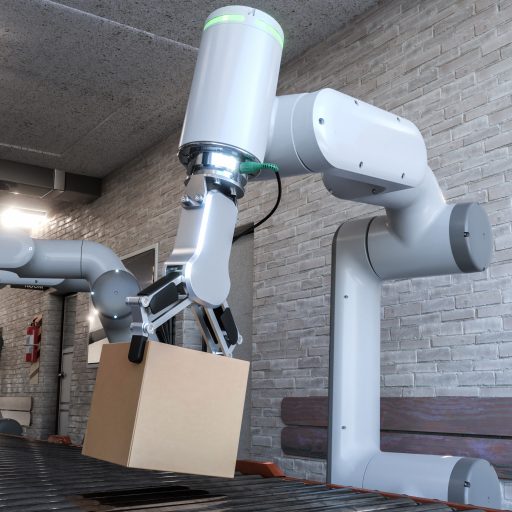
Collaborative robots are characterized by their flexible and portable design, unlike conventional industrial robotics. Their most common format is a multifunctional articulated arm that can perform a wide range of tasks:
- Assembly and precision: tasks such as screwing, welding, and assembly.
- Quality control and inspection: machinery monitoring and real-time data analysis.
- Handling and logistics: pick-and-place, packaging, and parts loading tasks.
To better understand why they have represented a revolution, we can compare some additional characteristics that differentiate them from traditional industrial robots:
| Traditional Industrial Robotics | Cobots | |
| Safety | Enclosed in a safety cage | Work safely alongside human workers |
| Programming | Complex code requiring specialized engineers | Easy and intuitive interface |
| Versatility | Perform a single task | Can perform different tasks |
| Cost-effectiveness | High investment that only large companies can afford | More affordable cost with a fast ROI |
Cobots: Job Replacement or Evolution?
One of the major debates surrounding automation is the fear that machines will replace humans. However, the philosophy behind cobots focuses on cooperating with people, not replacing them.
In one of the episodes of our HoM podcast, we discussed this issue with Darío Samaniego, CEO of SynergyTech and an official distributor of advanced robotics (Unitree), who was joined in the studio by the robot Aebor.
When asked whether robots are going to replace workers, Aebor’s answer was clear: “There is no battle; without a human behind me, I am just metal”. Darío Samaniego went on to explain this reality, stating that machines will not replace people, but rather that occupations will evolve. Although some repetitive jobs may disappear, many new employment opportunities will emerge.
In this way, by taking on the heaviest, most monotonous, or most dangerous tasks, cobots optimize processes and increase overall factory productivity. They also significantly improve working conditions and the safety of human workers. Far from being limited to a single industry, their adaptability allows cobots to take on critical processes across multiple operational sectors:
- Logistics and warehouse automation. They streamline workflows through inventory sorting, order picking, packaging, and automated palletizing.
- Food and beverage industry. They handle secondary packaging, food handling in clean environments, and visual quality control of fresh products.
- Healthcare and laboratory environments. They automate pipetting, biological sample handling, and repetitive chemical testing, minimizing the risk of human contamination.
- Electronics and micro-assembly. They provide millimeter-level repeatability for positioning microcomponents, soldering circuits, and carrying out functional tests with virtually no margin for error.
- Surface finishing. They ensure maximum precision and uniformity in sanding, polishing, stripping, and buffing materials such as wood, metal, and plastic.
Collaborative robotics is no longer a technology of the future; it has become a competitive advantage that enables SMEs to innovate, scale, and transform their production models.