
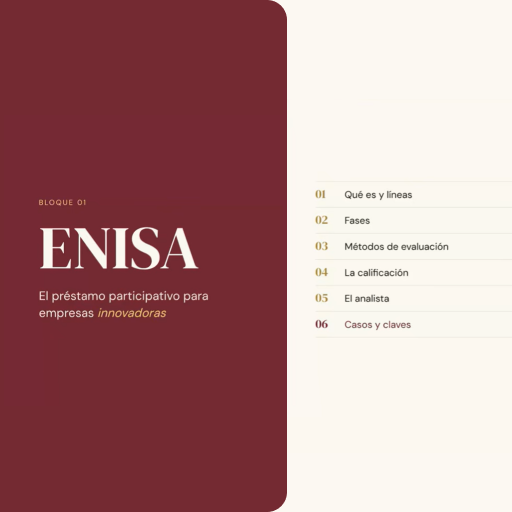
ENISA Funding and the Startup Certification: Practical Keys to Boost Your Company's Growth
Share:
Scaling a technological and industrial solution requires smart capital that does not compromise financial viability or corporate structure in early stages. For companies validating technology and seeking to consolidate their business model in the market, ENISA (Empresa Nacional de Innovación) participative loans and the Startup Certification (Certificado de Empresa Emergente) have become two fundamental strategic tools.
In a recent training session organized at La Lonja de la Innovación and led by Candi Díaz, Public Funding Consultant at CRESCERA, we reviewed the real requirements, evaluation criteria, and common mistakes when applying for both instruments. You can access the full recording or explore in this article the main practical takeaways from the session so you can prepare your application rigorously.
ENISA: Participative Funding Without Collateral or Equity Dilution
Unlike a non-repayable grant, ENISA offers participative loans aimed at co-financing viable and innovative business projects. Their main appeal compared to traditional banking lies in two key factors for any growing company:
- No personal guarantees or collateral: It does not require putting the partners' personal assets at risk or providing bank guarantees.
- No equity dilution: It allows you to secure funding without giving up equity shares in the company, unlike rounds funded exclusively through venture capital.
- Open window and agile timelines: The system operates with European revolving funds (replenished as loans are repaid) and remains open year-round. The average resolution period is currently around 45 to 60 days.
Terms, Amounts, and Available Lines
Currently, the former general lines have been consolidated under the Startups and SMEs (Startups y Pymes) line, which offers amounts ranging from €25,000 to €1.5 million. Although the theoretical framework allows for long terms, loans are typically granted with a 2-year principal grace period and a 5-year repayment period (7 years in total). Additionally, keep in mind that if the accumulated outstanding risk exceeds €300,000 (either in a single loan or by combining several, leaving at least one year between applications), auditing the annual financial statements becomes mandatory.
The interest rate is divided into two tranches: a first fixed/variable tranche referenced to Euribor (+4% or +6% depending on the rating assigned by the analyst) and a second variable tranche linked to the company's profitability if it generates profits.
Alongside the general line, there are four thematic lines linked to different ministries: Digital Female Entrepreneurs (Emprendedoras Digitales), AgroInnpulso, Cultural Industries (Industrias Culturales), and Innovation x Climate (Innovación x Clima, aimed at solutions addressing climate risks and emergencies).
How ENISA Evaluates Your Project: What Analysts Look For
The process consists of four phases, with admission and analysis being the most decisive. During the admission phase, ENISA verifies the absence of defaults in credit delinquency registries (such as ASNEF) and sector eligibility: purely financial or real estate activities are generally excluded (except for subscription-based SaaS tech models that do not charge transaction fees), as well as unregulated sectors or those with high regulatory friction, such as cryptocurrencies.
During the analysis phase, the evaluation varies depending on the company's age:
- Companies under 2 years old (complex method): Lacking an extensive accounting history, the weight falls on qualitative criteria: the strength of the team, the viability of the business model, and market evidence.
- Companies over 2 years old (simple method): The analysis focuses on historical financial statements. Having negative equity (fondos propios negativos) in the submitted annual accounts results in automatic rejection, making it essential to review and clean up the balance sheet before the fiscal year-end, as ENISA analyzes the latest filed annual accounts.
4 Common Mistakes to Avoid in Your Application
During the session at La Lonja, four critical points were highlighted that make the difference between an approved application and a rejected one:
- Unrealistic financial projections: The analyst enters your figures into a basic ratio calculator (solvency, indebtedness, liquidity, and cash flow). Presenting exponential growth without documentary backing undermines credibility. Furthermore, if you apply for a second ENISA loan in the future, they will evaluate whether you fulfilled the business plan submitted in the first one.
- Lack of commercial evidence in early stages: If your company was incorporated only a few months ago and has no revenue yet, you need to demonstrate traction through signed contracts, genuine letters of intent from potential clients, or validated waiting lists.
- Applying before securing the round: ENISA operates under the principle of co-financing (it requires an equivalent contribution of equity or private investment). It is advisable not to submit the application without having at least 50% of the capital committed, as successive extensions to close the round after approval have been eliminated, and capital already spent prior to the application does not count in the cash-flow analysis.
- Cross-transactions with group companies: If the applicant company holds shares in other companies or depends on a parent company with cross-commercial operations, the complexity of the analysis will increase and consolidated financial statements may be required.
Startup Certification: The Key to the Startup Law
The second pillar addressed during the session was obtaining the Startup Certification (Certificado de Empresa Emergente), also managed through ENISA under the Law for the Promotion of the Startup Ecosystem (Ley de Fomento del Ecosistema de las Empresas Emergentes).
This seal certifies the innovative and scalable nature of the company, unlocking significant tax advantages (such as a reduced Corporate Income Tax rate of 15% during the first fiscal years with a positive taxable base or the deferral of tax debts), social security contribution bonuses, and advantages for attracting talent and investment.
Its application process shares much of the documentary logic of an ENISA loan: it requires demonstrating technological or business model innovation, scalability, and a solid plan backed by verifiable metrics and evidence, making it a natural and complementary step in the financial strategy of any growing tech company.
Validate Your Technology and Accelerate Your Time-to-Market at La Lonja de la Innovación
Having a solid financial structure is an essential complement to bringing a technological solution to market. At La Lonja de la Innovación, the open innovation hub of the Port Authority of Huelva within Telefónica Open Future, we turn the Port of Huelva into a living lab where companies validate their developments under real operational conditions, connect with industry, and generate business opportunities.
If you are developing technological solutions for the port, logistics, industrial, or energy sectors, discover our open challenges, leverage our FIWARE iHub Premium ecosystem, and get in touch with our team to put your technology to the test in a real-world environment.
👉 Missed the session or want to review all the details? Access the full recording of the talk on ENISA funding and the Startup Certification here.