NextPort presents its solution in Amsterdam with the Port of Huelva
Share:
NextPort, a company from La Lonja de la Innovación ecosystem, seeks to expand to more ports in Europe after its pilot tests in Huelva, Algeciras and Santander.
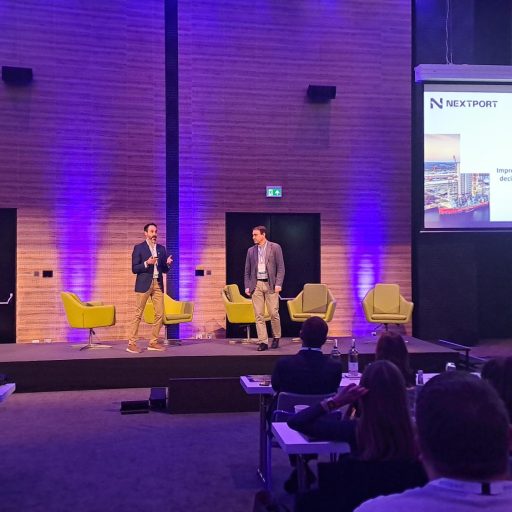
Recently, NextPort, a company from La Lonja de la Innovación ecosystem, traveled to Amsterdam, one of the main ports in Northern Europe, to participate in the Smart Digital Ports of the Future (SDP) conference. There, together with the Port Authority of Huelva, they presented their portfolio of technological solutions applied to logistics and showed how their Digital Twin technology and their data-based ecosystem approach are transforming the world of port operations.
The participation in this conference was led by Ángel Martínez Cavero, Head of Product Adoption in Ports at NextPort, and Mafran Martínez, Technology Director of the Port Authority of Huelva. Together they presented the continuous collaboration between the Digital Twin and its applications for operational optimization at the Port of Huelva.
The strategy of the Port of Huelva
The Port of Huelva has placed Digital Transformation at the center of its strategy. Therefore, in collaboration with Telefónica, Indra and Ayesa, it is building a solid technological ecosystem that leverages the value of data to drive innovation in applications such as the Port Community System, based on the European FIWARE standard.
NextPort's contribution to the Port of Huelva also fits this approach, focusing on optimizing maritime operations and market intelligence, all supported by innovation funding from Puertos del Estado through the Ports 4.0 funds.
The fact that NextPort is part of the La Lonja de la Innovación ecosystem underlines the importance of our space as a platform for developing disruptive solutions for the sector. La Lonja acts as a meeting point that connects the real needs of ports with the talent and technology of innovative companies.
The NextPort solution
As Ángel Martínez Cavero explains, NextPort's vision is "for ports to base their decisions on data by default". To achieve this, they integrate "port infrastructure, metoceanographic data, vessel status and maritime services into an operational digital twin", providing actionable information to people and systems through controlled event flows. Furthermore, this is "fully interoperable with PCS/TOS/PMS/GIS, which contributes to improving efficiency, while laying the foundations for quantifiable decarbonization and resilience".
This integration ensures that operations teams no longer have to search for fragmented information in multiple sources. Instead, they have timely and reliable data at their fingertips, allowing them to make accurate decisions based on the specific characteristics and limitations of their port.
The next step is to integrate this unified dataset with advanced digital tools such as AI and digital twins. On one hand, the digital twin offers an interactive and navigable model that enhances the experience of the operations team by integrating vessel calls, infrastructure, metoceanic information, and operational status. On the other hand, AI offers two critical capabilities: learning from the past and anticipating the future.
In conclusion, the integration of AI with the Digital Twin will enable a new paradigm for port call management, transforming the current stressful and reactive decision-making into a holistic optimization capability for all stakeholders.
The presentation of this solution in Amsterdam is a recognition of the innovation of NextPort's technology and the role of the Port of Huelva and La Lonja de la Innovación, which continue to position themselves as benchmarks for port digital transformation.